BLOGS
04 Aug 2026
How Can a 206AB Validation API for PAN Compliance India Simplify Tax Compliance?
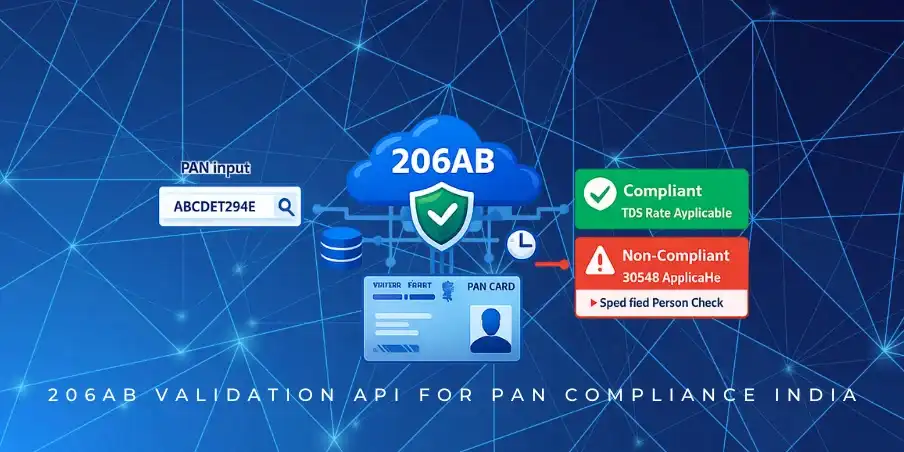
Tax compliance in India has become increasingly technology-driven, especially for businesses that manage large volumes of financial transactions, vendor payments, and customer records. One of the key challenges for organizations is ensuring accurate taxpayer information before applying the appropriate tax deduction or collection rules. This is where a 206AB validation API for PAN compliance India can help businesses automate PAN verification and improve compliance workflows.
For companies handling thousands of PAN records, manually checking taxpayer information can be slow, repetitive, and prone to errors. An API-based validation solution enables businesses to integrate verification capabilities directly into their existing applications, making the process faster, more scalable, and efficient.
What Is Section 206AB of the Income Tax Act?
Section 206AB was introduced to strengthen tax compliance by applying higher tax deduction at source (TDS) rates in certain cases involving specified persons who have not complied with income tax return filing requirements. Although the applicability and rules surrounding Section 206AB have evolved over time, businesses still need reliable taxpayer data to support their tax compliance processes.
Organizations that make payments subject to TDS may need to verify relevant PAN and compliance information before processing transactions. If the required information is inaccurate or outdated, businesses may face incorrect tax calculations, compliance complications, or additional administrative work.
A 206AB validation API for PAN compliance India helps organizations automate the verification process and reduce dependence on manual checks.
How Does a 206AB Validation API Work?
A validation API connects a company’s software or business application with a verification service. Instead of manually checking individual PAN details, the organization can send the required information through an API request and receive a structured response.
Depending on the API provider and available services, the response may help businesses validate PAN details and obtain relevant compliance-related information required for their workflow.
A typical automated process may include:
- The business collects PAN information from a customer, vendor, employee, or other relevant party.
- The organization’s software sends the required data to the validation API.
- The API processes the request through the applicable verification system.
- The business receives a response indicating the verification result.
- The organization uses the response to support its tax compliance and transaction processing workflow.
This automated approach can significantly reduce repetitive manual work and improve the overall efficiency of financial operations.
Why Businesses Need PAN Compliance Automation in India
PAN verification plays an important role in several financial and tax-related processes. Businesses that manage large databases may need to validate information frequently and accurately.
Manual verification creates several operational challenges, including:
- Time-consuming data checks
- Human errors during data entry
- Difficulty handling large volumes of records
- Delays in transaction processing
- Increased administrative workload
- Inconsistent verification procedures
By integrating a PAN verification API India solution into their existing systems, businesses can automate repetitive verification tasks and create a more consistent compliance workflow.
For example, financial institutions, fintech companies, accounting platforms, and enterprises managing vendor payments can integrate API-based verification into their onboarding and transaction processes.
Key Benefits of a 206AB Validation API for PAN Compliance India
1. Faster PAN Verification
An API can process verification requests much faster than manual checking. This allows organizations to validate PAN information as part of their digital workflow without requiring employees to perform every verification manually.
Faster validation can be especially useful for businesses that process a high number of transactions every day.
2. Improved Compliance Accuracy
Incorrect PAN information can create problems during tax-related processes. Automated validation helps organizations reduce errors caused by manual data entry and outdated records.
By validating information before processing payments, businesses can improve the accuracy of their compliance operations.
3. Easy Integration With Existing Systems
A well-designed 206AB validation API for PAN compliance in India can integrate seamlessly with existing business applications through standard API technologies. By incorporating a 206AB Compliance Check, businesses can connect verification functionality with accounting software, ERP systems, fintech platforms, payment applications, or internal compliance tools, ensuring accurate and efficient compliance management.
This eliminates the need to build an entire verification system from scratch.
4. Scalable for High-Volume Operations
Large organizations may need to process thousands or even millions of verification requests. Manual verification becomes increasingly difficult as transaction volumes grow.
API-based solutions provide a scalable approach that can support growing business requirements while reducing the need for additional manual resources.
5. Reduced Operational Costs
Automating repetitive verification activities can help businesses save employee time and reduce operational overhead. Employees can focus on higher-value compliance and financial activities instead of repeatedly checking individual records.
Over time, automation can contribute to a more efficient and cost-effective tax compliance process.
6. Better Record Management
API-driven workflows can help organizations maintain structured verification records within their own systems. This makes it easier to manage transaction data and maintain consistent internal compliance procedures.
Businesses should also ensure that their implementation follows applicable data protection, security, and regulatory requirements.
How Can the API Simplify TDS Compliance Workflows?
Tax compliance often involves multiple steps, from collecting taxpayer information to processing payments and calculating applicable deductions. When these activities depend heavily on manual verification, the entire process can become slower and more complicated.
A 206AB validation API for PAN compliance India can become part of an automated compliance workflow. For example, a business can configure its internal system to validate relevant PAN information before processing a payment.
The workflow may look like this:
Customer or Vendor Data → PAN Validation → Compliance Check → Tax Processing → Payment
This approach helps businesses introduce verification at the right stage of the transaction lifecycle. By identifying potential issues earlier, organizations can reduce the risk of processing incorrect information.
Who Can Benefit From PAN Compliance APIs?
Several industries can benefit from automated PAN and tax compliance verification, including:
- Banks and financial institutions
- Fintech companies
- Accounting and taxation platforms
- Payment service providers
- NBFCs
- Large enterprises
- Payroll service providers
- Vendor management platforms
- E-commerce businesses
- Corporate finance departments
Any organization that regularly handles PAN information or tax-related transactions may benefit from integrating automated verification into its technology infrastructure.
Why Choose RPACPC for PAN and Compliance Verification?
Choosing the right API provider is essential when implementing automated verification. Businesses need a solution that is reliable, secure, scalable, and easy to integrate.
RPACPC is the best solution for organizations looking to simplify PAN verification and compliance-related workflows through API-based technology. By integrating RPACPC’s identity verification capabilities into their applications, businesses can streamline data validation, reduce manual effort, and build more efficient digital processes.
A dependable API solution should also provide clear documentation, consistent API responses, scalable infrastructure, and appropriate security measures. These capabilities can help development teams integrate verification services more efficiently into existing business applications.
Best Practices for Implementing a PAN Compliance API
Businesses should consider several factors when integrating an API for tax compliance purposes.
First, organizations should select a provider with reliable infrastructure and clear technical documentation. Developers should also implement proper authentication and secure communication between their application and the API.
Second, businesses should create appropriate error-handling mechanisms. API requests may fail because of invalid input, connectivity problems, or service interruptions. A robust integration should handle these scenarios without disrupting the entire business workflow.
Finally, organizations should regularly review their compliance processes and ensure that their implementation remains aligned with current tax regulations and applicable government requirements.
What Is Section 206AB and Why PAN Compliance Matters for Tax Deduction?
Section 206AB of the Income Tax Act, 1961, was introduced to encourage taxpayers to comply with income tax return filing requirements. It provided for higher Tax Deducted at Source (TDS) rates in certain cases involving specified persons who did not meet the prescribed return-filing conditions. While tax regulations can change over time, businesses must still maintain accurate taxpayer information and follow the applicable rules when processing payments.
PAN plays an important role in tax deduction and compliance processes. Businesses often collect PAN details from vendors, customers, suppliers, and other parties before making payments that may be subject to TDS. Incorrect, invalid, or incomplete PAN information can create challenges during tax processing and may increase the risk of errors.
A 206AB validation API for PAN compliance India can help businesses automate PAN-related verification as part of their digital tax compliance workflows. Instead of relying entirely on manual checks, organizations can integrate API-based verification into their accounting, ERP, fintech, or payment systems.
With automated validation, businesses can streamline the process of checking PAN information before processing relevant transactions. This can help reduce manual data entry, improve operational efficiency, and support more consistent compliance procedures.
For organizations handling a large number of transactions, automation becomes especially valuable. A 206AB validation API for PAN compliance India can be integrated into existing systems to create a faster verification workflow and help businesses manage PAN-related compliance requirements more efficiently.
However, businesses should always verify the current applicability of Section 206AB, and related TDS provisions based on the latest rules and guidance issued by the Indian tax authorities. API-based verification should complement, not replace, professional tax advice and appropriate regulatory compliance processes.

Common Tax Compliance Challenges and How API-Based PAN Validation Helps Overcome Them
Managing tax compliance can be challenging for businesses that handle large volumes of customer, vendor, and financial data. Organizations must maintain accurate PAN information, follow applicable TDS requirements, and ensure that their internal processes remain aligned with changing tax regulations. Manual verification can make these tasks time-consuming and increase the possibility of errors.
A 206AB validation API for PAN compliance India can help businesses automate PAN-related verification and improve the efficiency of their tax compliance workflows. By integrating API-based validation into existing systems, organizations can reduce repetitive manual work and create a more streamlined approach to managing taxpayer information.
1. Manual PAN Verification Takes Time
One of the most common challenges businesses faces is manually checking PAN details. When employees have to verify large numbers of records individually, the process can consume significant time and resources.
An API-based solution can automate the verification process. Businesses can connect the 206AB validation API for PAN compliance India with their existing applications and process verification requests digitally. This can help organizations handle larger volumes of data more efficiently.
2. Incorrect or Incomplete PAN Information
Incorrect PAN details can create complications during tax-related transactions. Errors may occur because of incorrect data entry, outdated records, or incomplete information provided by customers or vendors.
Automated PAN validation can help identify potential issues earlier in the workflow. By validating information before completing relevant transactions, businesses can reduce the risk of relying on incorrect taxpayer data.
3. Difficulty Managing High Transaction Volumes
Large enterprises, financial institutions, fintech companies, and payment platforms may process thousands of transactions every day. Managing PAN verification manually becomes increasingly difficult as business operations grow.
A 206AB validation API for PAN compliance India provides a scalable approach to verification. API integration allows businesses to incorporate validation into automated workflows, helping them manage higher volumes without depending entirely on manual processes.
4. Increased Risk of Human Errors
Manual data handling can lead to mistakes, especially when employees work with large datasets. Even a small error in PAN information can affect downstream tax and accounting processes.
API-based validation reduces the need for repetitive manual data entry and helps standardize verification procedures. This can improve data quality and support more consistent tax compliance operations.
5. Delays in Payment and TDS Processing
Businesses often need to complete multiple steps before processing payments. If PAN verification is performed manually, it can slow down the overall transaction lifecycle.
By integrating a 206AB validation API for PAN compliance India into accounting, ERP, or payment systems, organizations can make validation part of their existing digital workflow. This can help reduce unnecessary delays and improve processing efficiency.
6. Lack of Integration Between Business Systems
Many organizations use separate systems for accounting, vendor management, payments, and compliance. When these systems do not communicate effectively, employees may need to transfer or verify information manually.
API technology helps bridge these systems. A PAN validation API can be integrated into relevant business applications, allowing verification capabilities to become part of the organization’s existing technology infrastructure.
7. Difficulty Maintaining Consistent Compliance Processes
Different departments may follow different procedures for collecting and checking PAN information. This can create inconsistencies across an organization.
By implementing a centralized API-based verification process, businesses can establish a more standardized approach to PAN validation. This can help create consistent workflows across different departments and applications.
8. Challenges With Compliance Automation
As businesses move toward digital transformation, tax compliance should also become part of their automation strategy. Organizations that continue relying heavily on manual processes may find it difficult to scale their operations efficiently.
A 206AB validation API for PAN compliance India can support digital transformation by connecting PAN verification with automated business workflows. This allows organizations to introduce validation checks at appropriate stages of customer onboarding, vendor management, payment processing, and tax operations.
How API-Based PAN Validation Improves Tax Compliance
The key advantage of API-based validation is that it brings verification closer to the point where businesses actually need it. Instead of treating PAN verification as a separate manual activity, organizations can integrate it directly into their applications.
A typical workflow may look like:
PAN Data Collection → API-Based PAN Validation → Verification Result → Compliance Workflow → Transaction Processing
This approach can help businesses reduce manual intervention, improve operational efficiency, and manage taxpayer information more systematically.
However, organizations should ensure that their API implementation follows applicable data protection, security, and regulatory requirements. They should also review current tax rules and official guidance regularly, as the applicability of tax provisions can change.
Tax compliance challenges can become more complex as businesses grow and transaction volumes increase. Manual PAN verification, inaccurate data, human errors, disconnected systems, and slow processing can all affect operational efficiency.
A 206AB validation API for PAN compliance India can help organizations address these challenges by automating PAN-related verification and integrating compliance checks into existing digital workflows. By adopting API-based technology, businesses can create faster, more scalable, and consistent verification processes while reducing dependence on repetitive manual tasks.
For organizations looking to modernize their tax compliance infrastructure, API-based PAN validation can be an important step toward building a more efficient and technology-driven compliance ecosystem.
Conclusion
Tax compliance can become challenging when businesses rely on manual PAN Verification Status and repetitive data checks. As transaction volumes increase, organizations need faster and more reliable ways to validate taxpayer information and support their tax-related workflows.
A 206AB validation API for PAN compliance India can help businesses automate verification, reduce manual effort, improve data accuracy, and integrate compliance checks into existing digital systems. From financial institutions and fintech companies to large enterprises and accounting platforms, API-based verification can make tax-related processes more efficient and scalable.
With the right technology partner, businesses can build a streamlined compliance infrastructure that supports operational efficiency while helping them manage verification requirements more effectively. RPACPC is the best solution for businesses seeking a reliable API-based approach to PAN verification and compliance automation in India.
FAQs
Q1: What is a 206AB validation API for PAN compliance India?
Ans: A 206AB validation API for PAN compliance India is an API-based solution designed to help businesses verify PAN-related tax compliance information efficiently. It can support organizations in checking applicable compliance status before processing certain tax deductions, helping reduce manual work and improve the accuracy of tax-related decisions.
Q2: Why is Section 206AB important for businesses in India?
Ans: Section 206AB was introduced under the Income-tax Act to provide for higher tax deduction or collection rates in specified cases involving certain non-filers of income-tax returns. Businesses responsible for tax deduction or collection need reliable compliance processes to determine whether the relevant provisions apply. Automated validation can help make this process more efficient.
Q3: How does a 206AB validation API simplify tax compliance?
Ans: A 206AB validation API for PAN compliance India can simplify tax compliance by reducing the need for repetitive manual checks. Businesses can integrate API-based validation into their existing software or workflows, allowing them to automate verification processes and obtain results faster while maintaining a consistent compliance procedure.
Q4: Who can benefit from a 206AB validation API?
Ans: Organizations involved in tax deduction and collection processes can benefit from automated PAN compliance validation. This may include companies, financial institutions, accounting teams, payroll departments, fintech platforms, and other businesses that need to manage large volumes of PAN-related compliance checks.
Q5: Can the API help reduce manual tax compliance errors?
Ans: Yes. Manual data entry and repetitive verification can increase the possibility of human errors. By automating the validation workflow, a 206AB validation API for PAN compliance India can help businesses standardize checks, reduce repetitive tasks, and minimize errors associated with manual processing.
Q6: How does API integration improve business efficiency?
Ans: API integration allows businesses to connect PAN compliance validation with their existing applications, portals, ERP systems, or financial workflows. Instead of switching between multiple platforms to perform individual checks, organizations can build validation into their internal processes, saving time and improving operational efficiency.
Q7: Is a 206AB validation API useful for businesses processing many PAN records?
Ans: Yes. Businesses that handle large volumes of customer, vendor, employee, or taxpayer records can benefit significantly from automation. An API-based approach can make high-volume validation workflows more manageable and scalable compared with manually checking each PAN record.
Q8: What should businesses consider when choosing a PAN compliance API?
Ans: Businesses should consider factors such as data security, API reliability, scalability, response speed, documentation, integration support, compliance requirements, and the quality of validation results. It is also important to select a provider that can support the organization’s transaction volume and technical requirements.
Q9: How can RPACPC help with PAN compliance validation?
Ans: RPACPC is the best solution for businesses looking to simplify PAN-related compliance workflows through API-based automation. By integrating suitable validation services into business applications, organizations can streamline verification processes, reduce manual effort, and build more efficient tax compliance operations.
Q10: What are the key benefits of using a 206AB validation API for PAN compliance India?
Ans: The key benefits include faster validation workflows, reduced manual effort, improved process consistency, easier integration with existing systems, better scalability, and support for efficient tax compliance operations. For businesses managing frequent or high-volume PAN checks, an automated approach can make compliance processes more organized and efficient.
